In 1914, Sir Ernest Shackleton set out to achieve what no human had ever done: cross the Antarctic continent on foot. Instead, he ended up presiding over a two-year masterclass in survival that defies every law of probability.
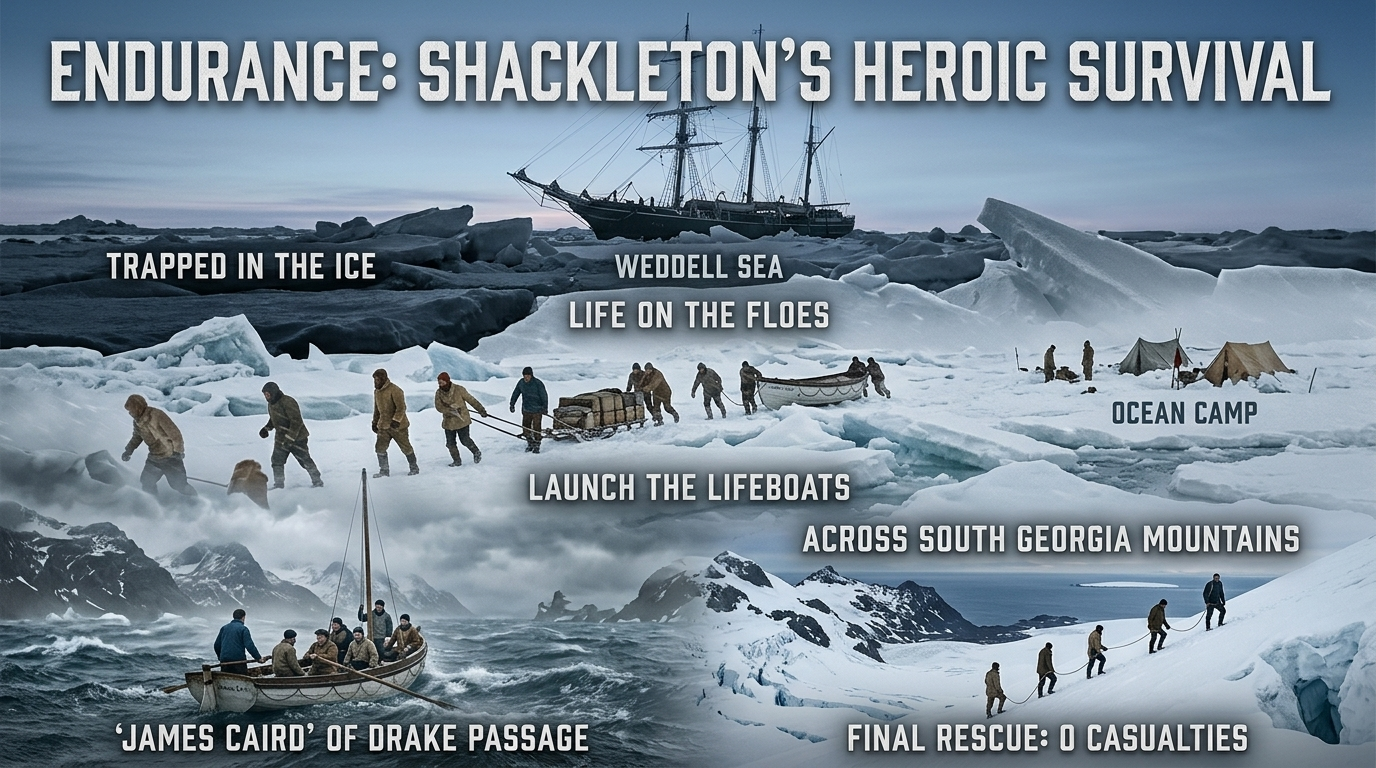
The ship was called Endurance. It lived up to its name, and then it died. But while the ship sank 10,000 feet to the icy floor of the Weddell Sea, not a single member of Shackleton’s 28-man crew was lost.
Here is how “The Boss” turned a catastrophic failure into a legendary victory.
The Trap: When Nature Rejects the Plan
The mission hit a wall—literally—in January 1915. The Endurance became “frozen like an almond in a piece of toffee.” For months, the crew drifted with the ice, far from their intended landing point.
Most leaders would have clung to the original mission. Shackleton didn’t. When the ice finally crushed the hull in October 1915, he watched his dream sink and immediately issued a new order: “Ship gone, stores gone. Now we go home.”
Survival on the Floes: The Psychology of the Long Game
For over 500 days, the crew lived in a white purgatory. They camped on shifting ice floes, hunted penguins for fuel and food, and battled temperatures that turn blood to slush.
Shackleton’s secret wasn’t just logistics; it was morale management. He knew that in a crisis, boredom and pessimism are as lethal as frostbite. He kept the men busy, maintained a strict routine, and sacrificed his own comfort to ensure the “difficult” personalities were kept close and integrated.
The Impossible Voyage: 800 Miles of Hell
By April 1916, the ice began to break up. The crew took to three small, open lifeboats, eventually reaching the desolate, uninhabited Elephant Island. They were safe from the sea, but they were still invisible to the world. Shackleton realized no one was coming to save them. He had to save himself.
He took five men and a 22-foot lifeboat, the James Caird, and launched into the Drake Passage—the most violent stretch of ocean on the planet. For 16 days, they battled 60-foot waves and hurricane-force winds to reach South Georgia Island.
The Final Pivot: Crossing the Mountains
They hit land, but on the wrong side of the island. To reach the whaling station, Shackleton and two others had to do what had never been done: cross the jagged, glacier-covered interior of South Georgia on foot with nothing but a rope and a carpenter’s adze.
When they walked into the whaling station, they were unrecognizable—blackened by blubber smoke, hair matted, clothes in rags. But they were alive.
The Legacy: Zero Casualties
On August 30, 1916, after four attempts to break through the pack ice, Shackleton returned to Elephant Island. Every single one of the 22 men left behind was standing on the beach.
In 2022, the wreck of the Endurance was found, sitting perfectly preserved in the freezing depths. It stands as a monument to a man who failed his objective but succeeded in his humanity.
Why This Matters Today (The Advisor’s Take)
Shackleton didn’t reach the South Pole. By the metrics of his original investors, he was a failure. But he is remembered because he possessed the rarest trait in leadership: The ability to abandon a plan to save the purpose.
Zero Casualties: The Brutal Leadership Lessons of Zero Casualties: The Brutal Leadership Lessons of Shackleton’s ‘Endurance’
In 1914, Sir Ernest Shackleton set out to achieve what no human had ever done: cross the Antarctic continent on foot. Instead, he ended up presiding over a two-year masterclass in survival that defies every law of probability.
The ship was called Endurance. It lived up to its name, and then it died. But while the ship sank 10,000 feet to the icy floor of the Weddell Sea, not a single member of Shackleton’s 28-man crew was lost.
Here is how “The Boss” turned a catastrophic failure into a legendary victory.
The Trap: When Nature Rejects the Plan
The mission hit a wall—literally—in January 1915. The Endurance became “frozen like an almond in a piece of toffee.” For months, the crew drifted with the ice, far from their intended landing point.
Most leaders would have clung to the original mission. Shackleton didn’t. When the ice finally crushed the hull in October 1915, he watched his dream sink and immediately issued a new order: “Ship gone, stores gone. Now we go home.”
Survival on the Floes: The Psychology of the Long Game
For over 500 days, the crew lived in a white purgatory. They camped on shifting ice floes, hunted penguins for fuel and food, and battled temperatures that turn blood to slush.
Shackleton’s secret wasn’t just logistics; it was morale management. He knew that in a crisis, boredom and pessimism are as lethal as frostbite. He kept the men busy, maintained a strict routine, and sacrificed his own comfort to ensure the “difficult” personalities were kept close and integrated.
The Impossible Voyage: 800 Miles of Hell
By April 1916, the ice began to break up. The crew took to three small, open lifeboats, eventually reaching the desolate, uninhabited Elephant Island. They were safe from the sea, but they were still invisible to the world. Shackleton realized no one was coming to save them. He had to save himself.
He took five men and a 22-foot lifeboat, the James Caird, and launched into the Drake Passage—the most violent stretch of ocean on the planet. For 16 days, they battled 60-foot waves and hurricane-force winds to reach South Georgia Island.
The Final Pivot: Crossing the Mountains
They hit land, but on the wrong side of the island. To reach the whaling station, Shackleton and two others had to do what had never been done: cross the jagged, glacier-covered interior of South Georgia on foot with nothing but a rope and a carpenter’s adze.
When they walked into the whaling station, they were unrecognizable—blackened by blubber smoke, hair matted, clothes in rags. But they were alive.
The Legacy: Zero Casualties
On August 30, 1916, after four attempts to break through the pack ice, Shackleton returned to Elephant Island. Every single one of the 22 men left behind was standing on the beach.
In 2022, the wZero Casualties: The Brutal Leadership Lessons of Shackleton’s ‘Endurance’
In 1914, Sir Ernest Shackleton set out to achieve what no human had ever done: cross the Antarctic continent on foot. Instead, he ended up presiding over a two-year masterclass in survival that defies every law of probability.
The ship was called Endurance. It lived up to its name, and then it died. But while the ship sank 10,000 feet to the icy floor of the Weddell Sea, not a single member of Shackleton’s 28-man crew was lost.
Here is how “The Boss” turned a catastrophic failure into a legendary victory.
The Trap: When Nature Rejects the Plan
The mission hit a wall—literally—in January 1915. The Endurance became “frozen like an almond in a piece of toffee.” For months, the crew drifted with the ice, far from their intended landing point.
Most leaders would have clung to the original mission. Shackleton didn’t. When the ice finally crushed the hull in October 1915, he watched his dream sink and immediately issued a new order: “Ship gone, stores gone. Now we go home.”
Survival on the Floes: The Psychology of the Long Game
For over 500 days, the crew lived in a white purgatory. They camped on shifting ice floes, hunted penguins for fuel and food, and battled temperatures that turn blood to slush.
Shackleton’s secret wasn’t just logistics; it was morale management. He knew that in a crisis, boredom and pessimism are as lethal as frostbite. He kept the men busy, maintained a strict routine, and sacrificed his own comfort to ensure the “difficult” personalities were kept close and integrated.
The Impossible Voyage: 800 Miles of Hell
By April 1916, the ice began to break up. The crew took to three small, open lifeboats, eventually reaching the desolate, uninhabited Elephant Island. They were safe from the sea, but they were still invisible to the world. Shackleton realized no one was coming to save them. He had to save himself.
He took five men and a 22-foot lifeboat, the James Caird, and launched into the Drake Passage—the most violent stretch of ocean on the planet. For 16 days, they battled 60-foot waves and hurricane-force winds to reach South Georgia Island.
The Final Pivot: Crossing the Mountains
They hit land, but on the wrong side of the island. To reach the whaling station, Shackleton and two others had to do what had never been done: cross the jagged, glacier-covered interior of South Georgia on foot with nothing but a rope and a carpenter’s adze.
When they walked into the whaling station, they were unrecognizable—blackened by blubber smoke, hair matted, clothes in rags. But they were alive.
The Legacy: Zero Casualties
On August 30, 1916, after four attempts to break through the pack ice, Shackleton returned to Elephant Island. Every single one of the 22 men left behind was standing on the beach.
In 2022, the wreck of the Endurance was found, sitting perfectly preserved in the freezing depths. It stands as a monument to a man who failed his objective but succeeded in his humanity.
Why This Matters Today (The Advisor’s Take)
Shackleton didn’t reach the South Pole. By the metrics of his original investors, he was a failure. But he is remembered because he possessed the rarest trait in leadership: The ability to abandon a plan to save the purpose.reck of the Endurance was found, sitting perfectly preserved in the freezing depths. It stands as a monument to a man who failed his objective but succeeded in his humanity.
Why This Matters Today (The Advisor’s Take)
Shackleton didn’t reach the South Pole. By the metrics of his original investors, he was a failure. But he is remembered because he possessed the rarest trait in leadership: The ability to abandon a plan to save the purpose.
In 1914, Sir Ernest Shackleton set out to achieve what no human had ever done: cross the Antarctic continent on foot. Instead, he ended up presiding over a two-year masterclass in survival that defies every law of probability.
The ship was called Endurance. It lived up to its name, and then it died. But while the ship sank 10,000 feet to the icy floor of the Weddell Sea, not a single member of Shackleton’s 28-man crew was lost.
Here is how “The Boss” turned a catastrophic failure into a legendary victory.
The Trap: When Nature Rejects the Plan
The mission hit a wall—literally—in January 1915. The Endurance became “frozen like an almond in a piece of toffee.” For months, the crew drifted with the ice, far from their intended landing point.
Most leaders would have clung to the original mission. Shackleton didn’t. When the ice finally crushed the hull in October 1915, he watched his dream sink and immediately issued a new order: “Ship gone, stores gone. Now we go home.”
Survival on the Floes: The Psychology of the Long Game
For over 500 days, the crew lived in a white purgatory. They camped on shifting ice floes, hunted penguins for fuel and food, and battled temperatures that turn blood to slush.
Shackleton’s secret wasn’t just logistics; it was morale management. He knew that in a crisis, boredom and pessimism are as lethal as frostbite. He kept the men busy, maintained a strict routine, and sacrificed his own comfort to ensure the “difficult” personalities were kept close and integrated.
The Impossible Voyage: 800 Miles of Hell
By April 1916, the ice began to break up. The crew took to three small, open lifeboats, eventually reaching the desolate, uninhabited Elephant Island. They were safe from the sea, but they were still invisible to the world. Shackleton realized no one was coming to save them. He had to save himself.
He took five men and a 22-foot lifeboat, the James Caird, and launched into the Drake Passage—the most violent stretch of ocean on the planet. For 16 days, they battled 60-foot waves and hurricane-force winds to reach South Georgia Island.
The Final Pivot: Crossing the Mountains
They hit land, but on the wrong side of the island. To reach the whaling station, Shackleton and two others had to do what had never been done: cross the jagged, glacier-covered interior of South Georgia on foot with nothing but a rope and a carpenter’s adze.
When they walked into the whaling station, they were unrecognizable—blackened by blubber smoke, hair matted, clothes in rags. But they were alive.
The Legacy: Zero Casualties
On August 30, 1916, after four attempts to break through the pack ice, Shackleton returned to Elephant Island. Every single one of the 22 men left behind was standing on the beach.
In 2022, the wreck of the Endurance was found, sitting perfectly preserved in the freezing depths. It stands as a monument to a man who failed his objective but succeeded in his humanity.
Why This Matters Today (The Advisor’s Take)
Shackleton didn’t reach the South Pole. By the metrics of his original investors, he was a failure. But he is remembered because he possessed the rarest trait in leadership: The ability to abandon a plan to save the purpose.