From Poverty to Power: How China Rewrote the Global Economic Playbook
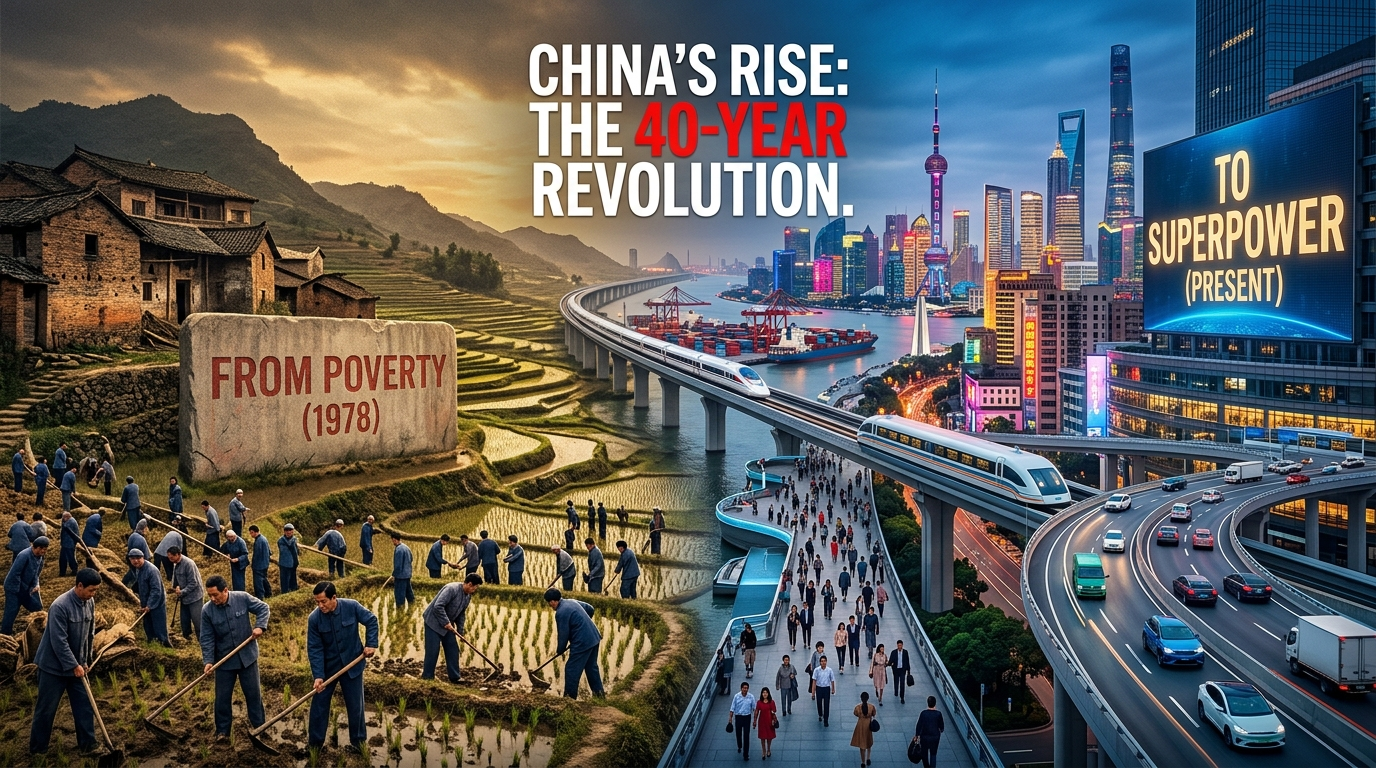
Forty years ago, China was an economic footnote—a nation where 90% of the population lived in extreme poverty. Today, it is the world’s second-largest economy, a technological titan, and a global superpower.
This wasn’t a miracle; it was a brutal, calculated pivot. By moving away from rigid ideological purity toward a philosophy of pragmatic experimentation, China executed the fastest economic expansion in human history.
The Foundation: Mao’s Chaos and the Hard Lessons Learned
To understand the rise, you have to acknowledge the depth of the fall. Under Mao Zedong, the Great Leap Forward and the Cultural Revolution weren’t just policy errors—they were catastrophic failures that led to famine and social paralysis.
However, even in this era, a foundation was being laid. The push for basic literacy and the institutionalization of women’s rights created a massive, untapped human capital pool. By the time the 1970s ended, China had a workforce that was uneducated by Western standards but ready for the discipline of industrialization.
Deng Xiaoping: The Architect of Reality
When Deng Xiaoping took the helm in 1978, he didn’t just “open the door”—he changed the incentive structure of an entire civilization. His mantra, “Crossing the river by feeling the stones,” is the ultimate lesson in agile strategy. He didn’t have a 40-year master plan; he had a commitment to what worked.
1. Decoupling the Individual
The Household Responsibility System was the first domino. By allowing farmers to keep and sell their surplus, China reintroduced the concept of profit. It turns out that when people are allowed to own the fruits of their labor, they work harder. Productivity didn’t just rise; it exploded.
2. The Factory Revolution
The Factory Manager Responsibility System shifted power from distant bureaucrats to the people actually running the floor. Efficiency became the metric of success, not political loyalty.
Education and Infrastructure: Investing in the Long Game
While the West focused on quarterly returns, China focused on decades.
- Compulsory Education (1986): A massive state mandate that ensured the next generation wouldn’t just be laborers, but technical operators.
- Special Economic Zones (SEZs): Shenzhen was a fishing village; today it’s the hardware capital of the world. By creating “sandboxes” for capitalism within a socialist state, China attracted foreign capital without losing control of its internal narrative.
The “Open Door” and Global Manufacturing
By the late 90s, China became the world’s factory. They didn’t do this by being “nice”; they did it by building the most efficient supply chains on the planet. They traded cheap labor for technology transfers, effectively “downloading” the world’s industrial knowledge until they could innovate on their own.
The Strategic Takeaway: Pragmatism Over Pride
The transformation of China proves that results are the only metric that matters. The country maintained an authoritarian political structure while adopting a hyper-competitive market economy—a “hybrid” model that many experts said would fail. It didn’t.
China’s journey from 90% poverty to less than 1% is a testament to what happens when a leadership stops making excuses for its failures and starts optimizing for global relevance.